
The first veterinary year for a rescue Collie is very different from the first year of a dog raised from puppyhood in one household. Your dog arrives with an incomplete history, uncertain prior care, and breed-specific considerations that many general-practice vets may not prioritize without prompting. This roadmap walks through what to schedule, what to ask for, and how to advocate for the care your dog actually needs.
Before the First Appointment: Gather the Record
The rescue should provide a medical file when you adopt. Request it in writing if they have not automatically sent it. A complete handoff file includes intake notes and weight history, vaccinations given with dates and lot numbers if available, spay or neuter surgical records, heartworm test results and any treatment history, fecal test results and deworming dates, microchip number and registration status, medications currently prescribed, and any behavioral notes from fostering.
If any of these are missing, follow up before the adoption is finalized. Reconstructing medical history after the fact is possible but slow, and the first-year care plan depends on knowing what has already been done.
The First 7-10 Days: Establishing Care
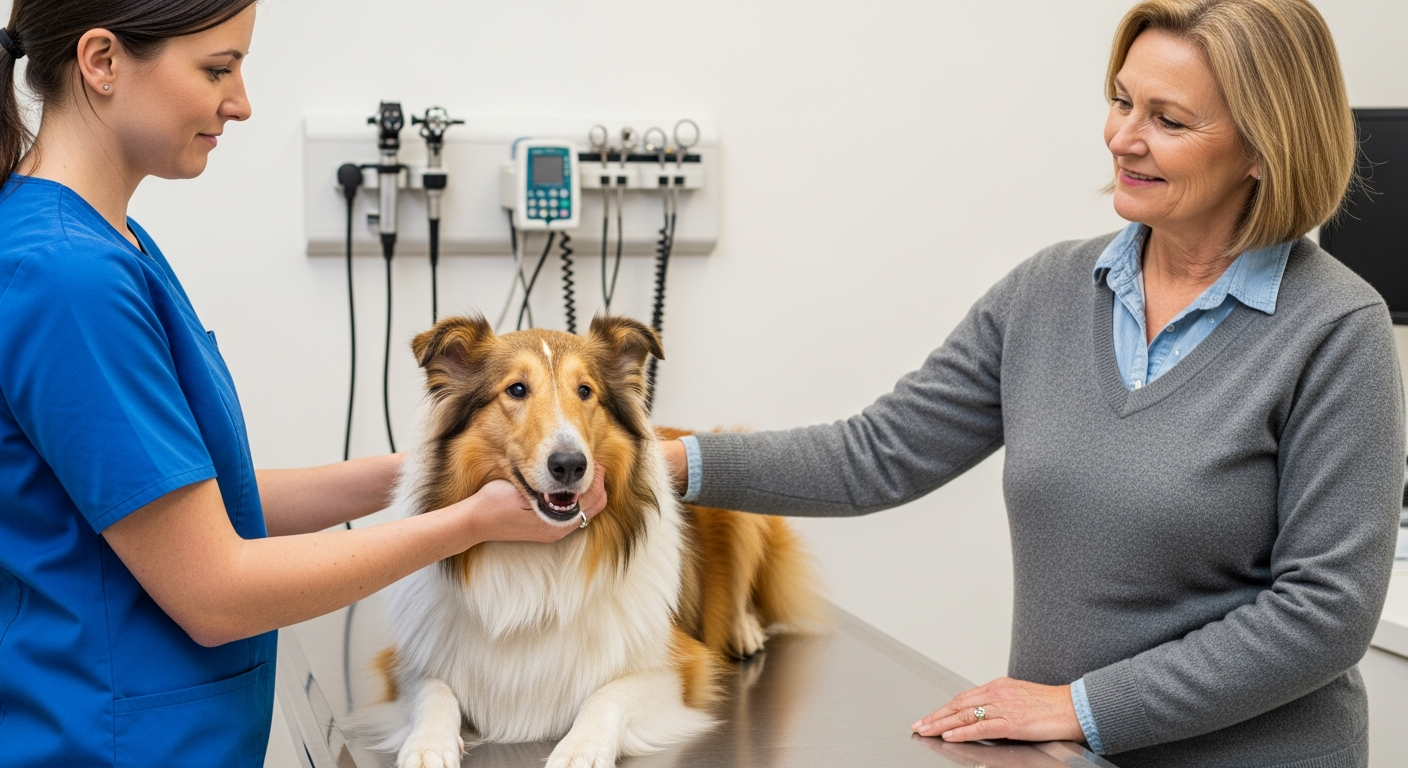
Schedule your initial wellness exam within the first week of the dog coming home. This visit establishes a baseline and opens a relationship with a clinic that will know your dog through normal and emergency situations. Choose a clinic that handles herding breeds regularly; urban clinics that see many working dogs or trial-competing dogs often have deeper familiarity with Collie-specific issues.
What to Bring
Bring the rescue medical file, a fresh stool sample in a sealed bag, a list of current medications with dosages, a written list of questions, and your dog. Offer the front desk the microchip number in advance so they can add it to the new patient file. A slow-feeder mat or calming treat in the exam room can help anxious dogs; some Collies arrive at the clinic triggered by prior shelter memories.
What the First Visit Should Cover
- Full physical exam including heart auscultation, abdominal palpation, lymph node check, and dental assessment
- Weight and body condition score, documented for future comparison
- Fecal test for intestinal parasites including giardia if not done recently
- Blood baseline: complete blood count, chemistry panel, and thyroid screen
- Heartworm antigen test if not done within the last three months
- Discussion of MDR1 genetic testing (see below)
- Review of vaccination status and scheduling of any boosters
- Parasite prevention plan matched to your geography
MDR1 Testing: The Essential Collie Test
The MDR1 gene mutation (now technically called ABCB1-1Δ) is present in roughly 70 percent of Rough and Smooth Collies in North America, and it fundamentally changes how certain medications are metabolized. Dogs homozygous for the mutation cannot properly pump out drugs that cross the blood-brain barrier, leading to neurological toxicity at standard doses of ivermectin, loperamide, acepromazine, and several chemotherapy agents.
Any rescue Collie without a documented MDR1 test should be tested at the first visit. The test is a simple cheek swab sent to a veterinary genetics lab. Results typically return within two to three weeks. Until you have results, every veterinary interaction should note that the dog's MDR1 status is unknown and that drugs flagged by the Washington State University veterinary pharmacology laboratory should be avoided or dose-adjusted.
The WSU Veterinary Clinical Pharmacology Laboratory maintains an updated list of affected drugs and handles the most widely used MDR1 test in the United States. For a broader overview of the gene and its effects across herding breeds, see our partner resource at the MDR1 Gene Guide.
Until MDR1 Status Is Known
Avoid ivermectin-based heartworm preventatives at labeled doses, avoid loperamide (Imodium), and flag the unknown status at every urgent care or emergency visit. Many safe alternatives exist; your vet simply needs to know to choose them.
The First-Year Visit Schedule
Week 1: Initial Wellness Exam
Baseline physical, bloodwork, fecal, MDR1 swab, medication review, parasite prevention plan.
Week 4-6: Follow-Up and Vaccinations
Address any abnormalities found in bloodwork, complete any needed vaccine boosters, review MDR1 results and update medical alerts.
Month 3: Integration Check
Optional visit for dogs that arrived underweight, stressed, or with skin or coat issues. Reassess body condition and address lingering concerns.
Month 6: Dental Baseline
Dental assessment and possible prophylactic cleaning, especially for dogs whose dental history is unknown. Discuss joint health for large-frame dogs.
Month 9: Heartworm and Parasite Recheck
Heartworm retest for dogs that arrived with uncertain history, fecal recheck, adjust parasite prevention seasonally.
Month 12: Annual Exam
Complete physical, annual bloodwork for trending, vaccine titers or boosters as recommended, discussion of future screening such as eye exams.
Breed-Specific Screenings to Discuss
Collies have a handful of well-documented hereditary concerns that deserve screening even in adulthood. Your rescue may not have records of prior screening, and catching issues early matters.
Ophthalmic Evaluation
Collie Eye Anomaly (CEA) is a developmental eye condition visible only on examination by a veterinary ophthalmologist, ideally using indirect ophthalmoscopy. Many rescues cannot afford specialty exams, so the status is often unknown. A one-time ophthalmologist visit during the first year establishes whether CEA, Progressive Retinal Atrophy, or other breed-relevant conditions are present. Even dogs with detectable CEA often have normal functional vision for life, but documentation helps future care.
Orthopedic Assessment
Hip dysplasia is less common in Collies than in Shepherds, but elbow dysplasia and patellar luxation occasionally appear. Ask your veterinarian to perform a hands-on orthopedic exam during the annual visit, particularly if you notice any bunny-hopping, hind-limb stiffness after rest, or intermittent lameness.
Thyroid Function
Hypothyroidism affects several herding breeds and can present with coat changes, weight gain, or subtle behavioral shifts. A full thyroid panel (not just total T4) provides meaningful screening and is inexpensive relative to the diagnostic value.
Medications and the Pharmacy Conversation
Every medication for a Collie should be reviewed against MDR1 considerations, even after you have test results, because new mutations occur and documentation can err. A simple practice that prevents serious events:
Ask Before Every New Prescription
- Is this drug on the MDR1-sensitive list?
- If yes, is there an equally effective alternative?
- If no alternative, is the dose adjusted for MDR1 status?
- What early signs of toxicity should I watch for?
- Is emergency support available after hours?
Keep a Medication Log
- Drug name and date started
- Dose and frequency
- Reason for prescription
- Any observed side effects
- Date discontinued and why
- Show this log at every new provider visit
Behavioral Veterinary Support
Some rescue Collies arrive with anxiety, reactivity, or trauma responses that do not respond to training alone. The veterinary behavior field has grown substantially, and a referral to a board-certified veterinary behaviorist or to a general-practice vet with advanced behavior training is appropriate for dogs whose welfare depends on medication alongside behavior modification.
Do not accept reflexive dismissal of behavioral concerns. A dog that cannot settle, cannot eat, cannot sleep, or presents danger to itself or others deserves the same medical attention a dog with a broken leg receives. The American Veterinary Society of Animal Behavior maintains clear position statements supporting this integrated approach.
Insurance and Financial Planning
Pet insurance is most valuable when purchased before conditions appear. For a newly adopted adult Collie, any documented condition at the first exam will typically be excluded as pre-existing. Some policies offer better rescue-specific terms; ask the rescue whether they have a referral partnership that waives certain pre-existing exclusions within the first weeks after adoption.
Whether or not you choose insurance, establish an emergency fund equal to the cost of one significant surgical procedure, typically two to four thousand dollars, before a crisis forces a choice. The rescue community is full of stories of families who could not afford an unexpected procedure in the first year; planning prevents those stories from being yours.
Coordinate With the Rescue in the First 30 Days
Many rescues offer limited medical support for conditions discovered within 30 days of adoption, particularly those that predate the placement. Report any concerning findings quickly; waiting until month three can close that door.
Building the Long-Term Care Team
By the end of the first year, the goal is a documented baseline, a confirmed MDR1 status, a stable weight, a clear vaccination and parasite plan, a dental baseline, and a primary care vet who knows your dog. That foundation allows the next decade of care to be preventative rather than reactive.
For a broader view of what life with a rescue Collie looks like beyond medical planning, our guide on the first 90 days with your rescue walks through the behavioral and emotional integration. If you are still making the adoption decision, the adoption process guide explains the path from application to homecoming.
Continue Your Rescue Planning
- Fostering Before Adoption — The decompression and integration playbook
- Adoption Process — Step-by-step application walkthrough
- First 90 Days — Behavior and bonding timeline
- Collie Drug Reactions — Detailed MDR1 medication reference